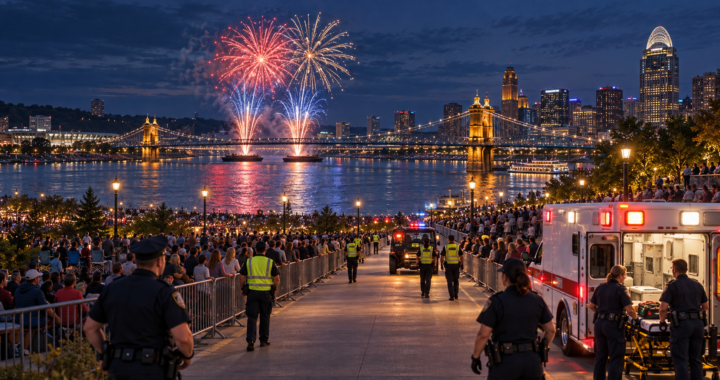
In 1977, a small Cincinnati, Ohio radio station announced plans to hold a birthday party including a fireworks show on the Ohio River at the end of August. With no understanding of the number of people who would attend, and involving police agencies from two states and the United States Coast Guard to cover the river, multiple meetings were held to establish guidelines for the peaceful operation of a day-wide event. The attendance was estimated at fifty thousand people on both sides of the Ohio River.
The day after the event, all of the parties met to assess the results, and the answers were disappointing to say the least. Cincinnati Police made one hundred ninety arrests, most of which were made more than three hours prior to the fireworks display. Once the fireworks started, police were responding to officer needs assistance calls and were having extreme difficulty getting through the crowds to help each other. Covington and Newport, KY Police were overwhelmed with the crowd size.
It was decided that the Kentucky police agencies would request the Kentucky National Guard for the second year to assist with crowd control. The interstate bridge traffic from Newport, Ky. into Cincinnati stopped during the fireworks requiring a police presence for the second year. A medical event involving one male required three ambulances being dispatched because they were unable to navigate the traffic congestion to respond. It took more than eighteen minutes for the ambulance to arrive. It was decided to close off the surface streets on both sides of the river to allow emergency vehicles to respond to emergencies.
The results of the second year were similar to the first. Cincinnati Police made over one hundred arrests (mostly liquor violations) and the bulk of those came prior to the start of the fireworks.
The third year the surface streets were closed in all of downtown Cincinnati. The traffic restriction allowed emergency vehicles more freedom. The police presence was also significantly increased to respond to the increasing crowd size with each passing year. Cincinnati Police officers’ off-days were cancelled and investigators were ordered back into uniform to staff the event. Sworn Private Police officers were ordered to work as well.
The Kentucky cities were the first to ban alcohol at the event, and Cincinnati followed suit in year five. That significantly reduced the number of arrests.
The event had now grown to over three hundred thousand visitors and the fireworks were fired from two barges in an effort to spread out the crowd.
Moving forward to the current time, the Feds have created Tier One level events. These involve the participation of all Federal Agencies and cover events like the Super Bowl and events involving the President of the United States. With their unlimited resources, they are able to shut down air space, drone activity and limit entry access to the venue.
Local communities have neither the personnel nor the resources to mount that level of security to a large scale event, but they still must be prepared for any potential situation that may arise.
Discover more from R. Barry Andrews
Subscribe to get the latest posts sent to your email.